Businesses have many options when choosing a workplace, including standalone offices, commercial complexes, office complexes, and business parks. While an office complex and a business park may appear similar, they are designed with different concepts, scales, and business requirements in mind.
Understanding the difference can help companies, investors, and professionals choose a commercial environment that better matches their operational needs.
An office complex generally focuses on providing multiple office spaces within a commercial development. A business park, on the other hand, is usually a larger planned development designed to accommodate multiple companies along with supporting infrastructure and amenities.
What Is an Office Complex?
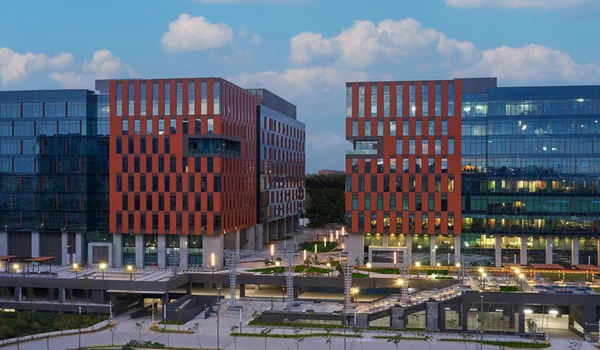
An office complex is a commercial property containing multiple office units or business spaces within one building or a group of connected buildings.
It may accommodate:
- Small and medium-sized businesses
- Professional firms
- Corporate offices
- Consultants
- Financial services
- Technology companies
- Service providers
Office complexes commonly provide shared facilities such as elevators, parking, security, power backup, common areas, and building maintenance.
They can be suitable for businesses looking for a professional office without having to operate from a standalone building.
What Is a Business Park?
A business park is generally a larger, planned commercial development designed specifically for businesses and organisations.
A business park may include several office buildings along with:
- Landscaped areas
- Large parking facilities
- Restaurants and cafés
- Retail and convenience services
- Meeting or conference facilities
- Recreational facilities
- Internal roads
- Security infrastructure
- Employee amenities
Business parks are often designed to create a complete working environment where companies can operate alongside supporting services.
The exact facilities and scale vary depending on the development.
Office Complex vs Business Park: Key Differences
| Factor | Office Complex | Business Park |
| Scale | Usually smaller | Generally larger |
| Buildings | One or a few buildings | Multiple buildings or large campus |
| Primary focus | Office accommodation | Complete business environment |
| Amenities | Basic to moderate | Often more extensive |
| Landscaping | May be limited | Usually more prominent |
| Parking | Shared or designated | Often larger-scale |
| Business types | SMEs and professionals | SMEs, large companies and corporates |
| Internal infrastructure | Relatively simple | More extensive |
| Employee facilities | Depends on property | Often broader |
| Development style | Compact commercial property | Planned commercial campus |
These are general differences rather than strict rules. Some modern office complexes may offer business-park-like facilities, while smaller business parks may have relatively limited amenities.
- Difference in Scale
One of the easiest ways to distinguish the two is scale.
An office complex can be a single multi-storey building containing dozens or hundreds of offices.
A business park generally covers a larger area and may contain multiple buildings connected through internal roads, walkways, parking areas, and shared facilities.
For businesses that need large campuses or multiple buildings, a business park may provide greater flexibility.
- Difference in Business Environment
An office complex typically concentrates businesses within a building or compact development.
A business park is usually designed as a broader business ecosystem.
Employees may have access to cafés, restaurants, convenience stores, landscaped areas, and other facilities without leaving the development.
This can create a more campus-like working environment.
- Difference in Amenities
Office complexes usually focus on essential commercial infrastructure.
These may include:
- Elevators
- Security
- Parking
- Power backup
- Common areas
- Fire-safety systems
Business parks may provide a wider range of amenities because of their larger scale.
These can include:
- Food courts
- Cafés
- Fitness facilities
- Recreational spaces
- Conference facilities
- Landscaped open areas
- Employee services
However, businesses should always verify actual facilities rather than assuming that every business park provides all these amenities.
- Difference in Parking
Parking requirements can vary significantly between businesses.
Office complexes may have basement, surface, or structured parking shared among tenants.
Business parks often have larger parking areas because they accommodate multiple office buildings and potentially thousands of employees and visitors.
For companies with a large workforce, parking capacity can therefore become an important factor when comparing the two.
- Difference in Accessibility
Both office complexes and business parks can be located in well-connected commercial areas.
However, business parks may have larger internal layouts, meaning employees and visitors may need to travel farther within the development.
Office complexes can offer a more compact experience where the parking area, entrance, elevators, and office units are relatively close together.
The better option depends on the location and transportation needs of the business.
- Difference in Employee Experience
Business parks often place greater emphasis on creating a complete workplace environment.
Employees may have access to:
- Food options
- Green spaces
- Convenience services
- Recreational facilities
- Walking areas
- Shared amenities
An office complex can also provide these facilities, but they are generally more dependent on the specific property.
For companies competing for talent, workplace environment can be an important consideration.
- Difference in Suitable Businesses
An office complex can work well for:
- Small businesses
- Professional firms
- Consultants
- Startups
- Financial services
- Service businesses
Business parks may be particularly suitable for:
- Large companies
- Technology companies
- Corporate offices
- Multinational companies
- Companies with large employee bases
- Businesses requiring multiple office buildings or large floor plates
Again, these are general patterns rather than fixed rules.
- Cost Considerations
Cost should be evaluated carefully because neither option is automatically cheaper.
Office complexes may offer smaller units and a more compact setup, which can work well for businesses with limited space requirements.
Business parks can involve higher occupancy costs because of larger premises, premium facilities, extensive common areas, and additional amenities.
Businesses should compare:
- Rent or purchase price
- Maintenance charges
- Parking costs
- Utility expenses
- Interior costs
- Facility charges
- Transportation expenses
The correct comparison is the total cost of operating from the property, not simply the quoted rent.
Which Is Better for Small Businesses?
For many small businesses, an office complex may be more practical.
A smaller company may not need extensive campus facilities and may prefer:
- Lower space requirements
- Convenient access
- Professional surroundings
- Shared infrastructure
- Flexible office sizes
However, a small business that values premium amenities or wants to be located alongside larger companies may also consider a business park.
Which Is Better for Large Companies?
Large organisations may find business parks attractive because they can offer larger office spaces, multiple buildings, extensive parking, and employee-focused amenities.
Companies with large workforces may also benefit from a campus-style environment.
However, a well-equipped office complex can still meet the requirements of a large company if the location, infrastructure, and available space are suitable.
How to Choose Between an Office Complex and Business Park
Businesses should consider the following questions:
How Much Space Do You Need?
If you require a small or medium-sized office, an office complex may be sufficient.
How Important Are Amenities?
If employee facilities and campus amenities are important, a business park may have an advantage.
What Is Your Budget?
Compare the complete cost of occupancy, including maintenance and other charges.
Where Do Employees Live?
Consider commute times and public transportation.
Do Clients Visit Regularly?
Client-facing businesses should prioritise accessibility, parking, visibility, and professional surroundings.
Will the Business Expand?
Companies expecting significant growth should consider whether larger or additional spaces are available.
What Should Investors Consider?
Investors should look beyond the property’s appearance and evaluate:
- Location
- Tenant quality
- Occupancy
- Rental demand
- Infrastructure
- Parking
- Property management
- Maintenance
- Future development
- Surrounding commercial activity
A business park is not automatically a better investment than an office complex. The property’s actual location, demand, tenant profile, pricing, and long-term potential are more important than the label used to describe it.
Frequently Asked Questions
Is an office complex the same as a business park?
No. An office complex generally refers to a commercial development containing multiple office spaces, while a business park is usually a larger planned development with multiple buildings and broader business amenities.
Which is better for a startup?
An office complex may be more suitable for startups that need a professional office with manageable space and operating costs. A business park can also work if its facilities and location match the startup’s requirements.
Are business parks more expensive?
They can be, particularly when they offer larger spaces and extensive amenities, but costs vary significantly between properties.
Do business parks have better facilities?
Business parks often provide more extensive amenities because of their larger scale, but the actual facilities depend on the specific development.
Is an office complex suitable for corporate offices?
Yes. A corporate office can operate from an office complex if the property provides sufficient space, infrastructure, accessibility, security, and other required facilities.
Final Thoughts
Office complexes and business parks both provide organised commercial environments, but they serve somewhat different needs.
An office complex is generally a more compact solution focused on office accommodation and essential shared facilities. A business park is usually a larger, campus-style development offering offices along with broader infrastructure and employee-oriented amenities.
The right choice depends on the business’s space requirements, budget, workforce, location, accessibility, parking, amenities, client needs, and future growth plans.
Rather than choosing based only on the property’s name, businesses should evaluate what the development actually provides and whether it supports their daily operations.
For a small professional firm, a well-connected office complex may be the ideal choice. For a large organisation seeking a campus environment with extensive facilities, a business park may offer greater advantages.
Ultimately, the best commercial workplace is the one that provides the right combination of functionality, convenience, cost, and long-term suitability for the business.